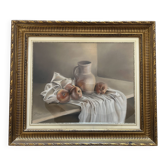
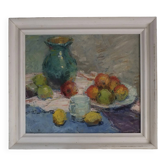
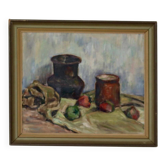
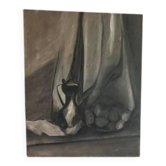
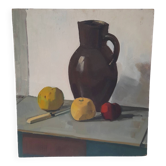
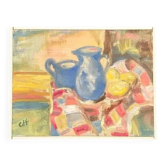
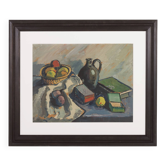
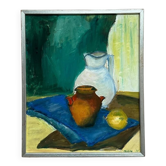
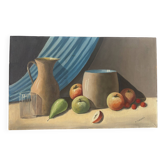
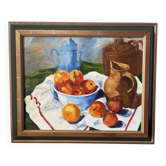
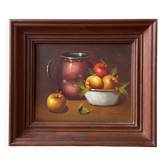
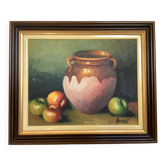
Oil painting by Emma Cionini Ciardi Venice 1879-1933
This item has found its owner, but other one-of-a-kind items await you. 👇
Discover similar items- Dimensions :
- H60 x W50 x D2
- Color :
- multicolour
- Material :
- linen
- Style :
- art deco
Oil on canvas, still life by the artist Emma Ciardi, 60 X 50 cm, in good condition, with a small tear visible in the photo. Emma Maria Ciardi Visani. Coming from a family of artists, she was introduced to painting from a young age by her father, Guglielmo Ciardi, a major figure, alongside Favretto, of the Venetian School of the living and a professor of "Vedute di paese e di mare" at the Academy of Fine Arts in Venice since 1894. Along with her father and her brother Beppe Ciardi, she painted from nature, like Guglielmo, who, as a student of Domenico Bresolin, had been initiated into the contemplation of nature. Emma Ciardi was an unconventional woman, in tune with her time, between the 19th and 20th centuries. She experienced the transition between the 19th and 20th centuries, at the heart of major revolutions that would transform the world. She chose to embrace the tradition of vedutism, whose masters were Carlevarijs and Canaletto, with a personal and inimitable style. Regularly present at the Biennale (from 1903 to 1932, except for the 1926 edition), she travelled, spoke English and French, and her Venetian accent resonated around the world. She participated in the most important national art exhibitions (Turin, Milan, Florence, Rome, Naples) and international ones (Munich, Barcelona, Paris, Buenos Aires, Pittsburgh, San Francisco). She organised solo exhibitions in London (1910, 1913, 1928), Paris (1914), New York (1924), Brussels (1925), and Chicago (1924). The most renowned gallery owners invited her to exhibit her works in Milan, London, Paris, and New York. Collectors from Europe and America purchased her paintings. Newspapers described her as "one of the most interesting and personal painters, painters and non-painters, for Ciardi is an artist who does not need such a distinction." Few women manage to turn their talent into a profession. Emma succeeded, and with an extraordinary entrepreneurial spirit for a woman of the early 20th century, she dedicated herself fully to her art. A true star of her time. Even D'Annunzio, passing through Venice, visited her in her studio where, without wasting time on idle chatter, she worked. She was convinced that a painter must express themselves with their brushes and colours, not with words, constantly repeating: "One does not paint while chatting unnecessarily." A woman of few words and great work ethic (as Ugo Ojetti wrote in the Corriere della Sera in 1909), she experienced public and critical recognition during the first three decades of the 20th century, receiving awards in Milan, Berlin, London, Paris, Brussels, New York, and San Francisco. A prolific painter, her works are exhibited worldwide. She works for an international clientele, from Venice to London and from New York to Buenos Aires.
Antique paintings: other similar vintage pieces
Discover more similar items- -18%
- -25%
- -40%
- -11%
- -14%
- -25%
- -7%