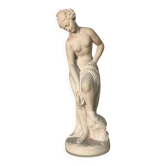
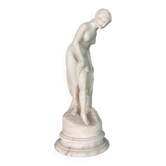
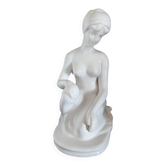
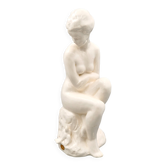
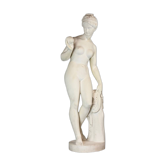
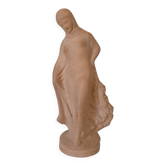
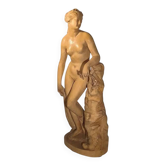
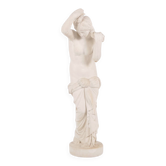
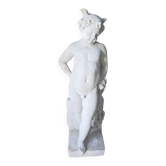
Important biscuit sculpture "The Bather" after Falconet – late 19th century.

- Dimensions :
- H65 x W20 x D26
- Color :
- white
- Material :
- ceramics, porcelain and earthenware
- Style :
- classic
This important biscuit sculpture entitled "The Bather", based on the iconic model by Étienne-Maurice Falconet, captivates with the purity of its matte material and the delicacy of its modelling, offering a highly refined interpretation of the famous theme of the young nymph emerging from the bath. The figure, slightly leaning forward, holds a soft drapery that glides along her legs with one hand, while her lowered gaze and the softness of her features give the whole a presence that is both modest and sensual. The biscuit, worked with remarkable precision, highlights the quality of the volumes, the roundness of the flesh, the fluidity of the folds, and the anatomical mastery inherited from the rococo style of which Falconet was one of the undisputed masters. The work rests on a circular base signed on the edge, simple yet reinforcing the elegance of the silhouette and emphasising the harmonious verticality of the composition. With its refinement, generous size, and excellent state of preservation, this sculpture constitutes a first-rate decorative piece, ideal for an interior seeking the alliance of French classicism and a timeless aesthetic. It appeals to connoisseurs of high-quality biscuit as well as collectors sensitive to faithful reinterpretations of the great models of the 18th century. Étienne-Maurice Falconet (1716-1791) is one of the great French sculptors of the 18th century, recognised for the grace of his figures and the refined elegance of the rococo style. Protected by Madame de Pompadour, he directed the sculpture workshop of the Manufacture de Sèvres where he created several iconic models, including The Bather and The Threatening Love. In 1766, Catherine II invited him to Russia to create the monumental equestrian statue of Peter the Great, the famous Bronze Horseman. His work, blending delicacy, movement, and anatomical mastery, remains a major reference in French and European sculpture. Period: Late 19th century. Perfect condition.
5 ()
Sculpture: other similar vintage pieces
Discover more similar items- -15%
- Sold out
- -20%
- -54%
- -16%
- -14%