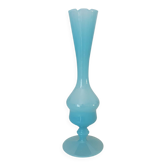
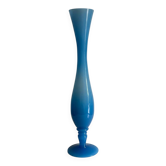
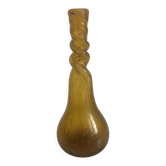
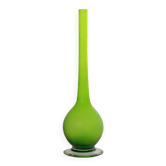
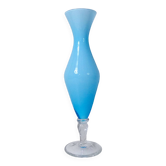
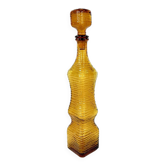
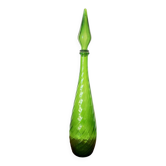
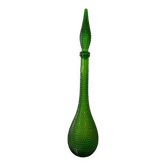
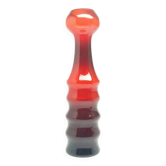
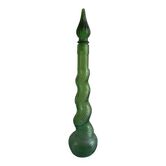
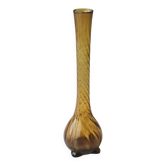
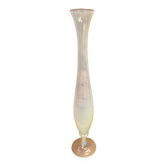
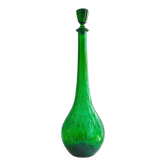
Mid-century modern vase, glass, Moser, Czechoslovakia, 1960s

- Dimensions :
- H29 x W7 x D7
- Color :
- orange
- Material :
- linen
- Style :
- mid-century
A tall, slender vase made in the 1960s by the renowned Czechoslovakian manufacturer Moser in Karlovy Vary. The structure consists of a glass, semi-transparent body with a smooth transition of tones: from deep amber-orange at the base, through intense shades of yellow, to a delicate, light yellow at the top. The surface of the vase is smooth and shiny, with rhythmically arranged convex segments emphasizing the organic, dynamic character of the form. The mouth flares out geometrically, contrasting with the wavy line of the body. The whole rests on a wide, stable base, whose colour refers to the lower part of the vessel. Typical of Czech glass from the 1960s, the combination of colour and dynamic texture indicates modern craftsmanship and pop-art boldness. Condition is very good – no cracks, chips or visible signs of use, with no signs of modern intervention. The vase seems to speak with the voice of an era where craftsmanship met the courage of form and colour. The shape resembles a dialogue between the artist and light: on one hand, the fluidity of lines and the juiciness of colours, on the other, the geometric discipline of the flared mouth. The eye flows over the regular, convex segments, which almost evoke the association with a gentle wave, giving the whole a youthful optimism typical of the mid-20th century. This glass does not hide in the background, but proudly presents an impressive combination of colour and shape. The vase can be used as a visual focal point in a mid-century modern living room, where it pairs well with light wood furniture and lacquered surfaces. An interesting effect is achieved when placed against a neutral background – displayed alone on a metal console or low sideboard. It also matches pop-art graphics or geometric, colourful textiles. Good complements are glass accents in other shades or single minimalist plants, so as not to overwhelm the expressive form of the vessel.