Malick Sidibe (1936-2016) The Fake Cowboy on a Moped 1974

- Dimensions :
- H50 x W40 x D0.1
- Color :
- grey
- Material :
- paper
- Style :
- contemporary
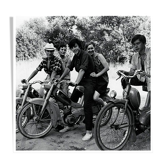
MALICK SIDIBÉ (1936–2016) Title: The Fake Cowboy on a Moped Date: 1974; printed 2011 Support: Pigment print on baryta paper Dimensions: 50 × 40 cm Signature: Signed, titled, and dated in the lower margin Visual and Technical Analysis: The Fake Cowboy on a Moped captures a playful and vibrant moment, characteristic of Malick Sidibé’s celebrated portraiture and social documentation in Bamako, Mali, during the 1970s. The photograph shows a subject striking a cowboy pose on a moped, embodying a performance that is both humorous and confident, reflecting the creativity and dynamism of the youth of that era. Sidibé’s mastery of composition, light, and timing is evident: the subject is sharp and perfectly highlighted against a neutral or minimalist background, allowing their personality and playful gesture to dominate the frame. Printed in 2011 on baryta paper with pigment ink, the work retains the luminosity, contrast, and tactile richness associated with high-quality fine art photographic printing. The tonal range emphasizes the textures—fabric, metal, and skin—while preserving the spontaneity and immediacy of the original 1974 photograph. The signature, title, and date inscribed in the lower margin confirm the work’s authenticity and provenance, enhancing its value for collectors. Collector Appeal: This print illustrates Sidibé’s unique ability to combine documentary realism with performative portraiture, celebrating individual expression, urban culture, and the vibrant social life of post-colonial Mali. The Faux Cowboy on a Moped is both visually captivating and historically significant, making it a highly sought-after acquisition for collectors of modern African photography, 20th-century portraiture, and photographic art prints. Malick Sidibé, born in 1936 in Soloba, Mali, is considered one of the most influential African photographers of his time. His work is distinguished by its dynamic black-and-white portraits, immortalizing Malian youth, their celebrations, dances, and moments of joy in Bamako. After starting out as a draftsman, he learned photography in the studio of Gérard Guillat-Guignard before founding his own studio in Bamako in 1958, in the Bagadadji neighborhood, a popular spot for local youth. He captured nightlife, weddings, and parties, revealing the freedom and carefree spirit of post-independence Malian youth. His images also bear witness to the cultural and social transformation of Mali, blending spontaneity with meticulous attention to detail. Recognized belatedly in Europe, his work has received numerous awards, including the Hasselblad Award in 2003 and the Golden Lion at the Venice Biennale in 2007. His unique style, combining reportage and portraiture, makes him a master of contemporary African photography. Malick Sidibé embodied the living memory of a hopeful generation, capturing the essence of a Mali in flux, while also reflecting the joie de vivre of its youth. His legacy continues to influence many artists today and continues to showcase African photography to the world.