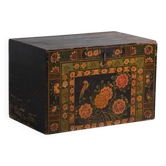
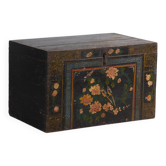
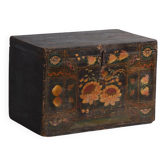
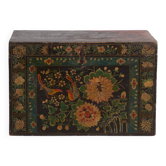
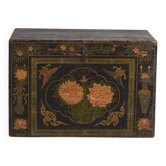
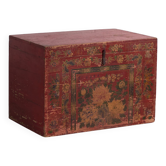
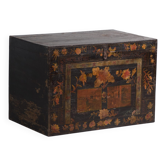
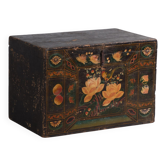
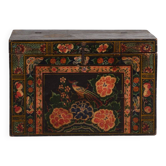
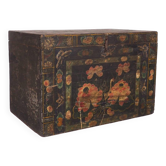
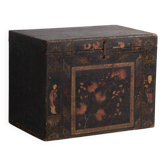
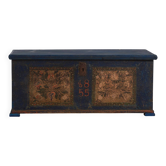
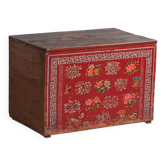
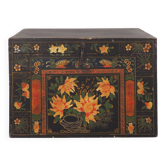
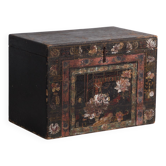
Antique chest painted in pine wood – China, around 1900

- Dimensions :
- H56 x W87 x D54
- Color :
- multicolour
- Material :
- chrome
- Style :
- world's craft
This ancient painted pine chest features a rectangular structure with a drop lid, wrought iron hinges and lock, and a polychrome painted decoration of peonies, vegetation, and birds on a dark background. It originates from northern China, from the late Qing dynasty, where the pine was crafted using a mortise and tenon joint and finished with polychrome paint on a natural lacquer background. In traditional Chinese furniture, painted chests were part of the trousseau — they were included in the bridal dowry — and contained textiles, festive clothing, documents, and personal items. The painted decoration on the front, sides, and lid was a statement of domestic prosperity and a vehicle for auspicious family symbolism. The body is constructed from solid pine. The structure is a closed rectangular volume with a drop lid mounted on wrought iron hinges, with a central lock also made of iron. The assembly uses mortise and tenon joints on an internal frame, and the sides finish with a small lower moulding. The interior retains the raw pine, while the exterior is fully painted. The front is painted with an elaborate polychrome composition: clusters of orange and red peonies (mudan 牡丹), intertwined vegetation, and small birds, all framed by a frieze of meander and floral motifs in cobalt and gold on a dark background. The peony is the queen of flowers and symbolizes wealth and honour; the birds add the motif of domestic harmony. The palette combines oranges, reds, greens, cobalt blue, and gold. Details. Dimensions: Length 87 cm – Depth 55 cm – Height 56 cm. Style: Qing Dynasty. Materials and techniques: Solid pine; wrought iron fittings; mortise and tenon assembly; painting on a natural lacquer background. Place of origin: China. Period: Late Qing Dynasty. Date of manufacture: Circa 1900. Condition / Observations: Good.
5 ()
Storage trunks & crates: other similar vintage pieces
Discover more similar items- -15%
- Sold out
- Sold out
- Sold out