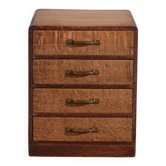
Small Japanese kotansu chest in oak – Japan, Shōwa period, around 1960
This item has found its owner, but other one-of-a-kind items await you. 👇
Discover similar items- Dimensions :
- H31 x W26 x D31
- Color :
- brown
- Material :
- oak
- Style :
- world's craft
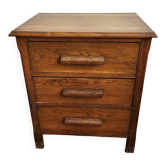
Small Japanese chest of drawers (kotansu) made of Japanese oak and shorea wood, crafted in Japan during the mid-Shōwa period. A compact piece that sits between an auxiliary chest and a Japanese storage unit, representative of 20th-century Japanese domestic furniture in its most understated form. During the Shōwa period, the tansu—an ancient Japanese craft typology—evolved into smaller formats and solid wood workshop productions. These small kotansu were used to store small treasures, supplies, sewing thread, jewellery, or stationery in a family room. Their size made them familiar on a desk, on a larger chest of drawers, or on a chigaidana shelf. It is constructed from Japanese oak (nara) on the front and sides, with interiors and reinforcements made of shorea and period plywood. The drawers are dovetail jointed—visible on the sides, a mark of quality in Japanese workshop joinery—and fitted with bronze handles in the shape of stirrups (warabite) set into recessed plates, allowing the piece to sit flat against any wall. The patina is warm and matte, with the grain of the nara visible and natural aging on the top, where signs of use and very light traces of sumi ink can be seen—presumably accounts or notes left by its former owner. The edges show gentle wear, and the hardware retains its original dark hue. Details. Dimensions: Width: 26 cm Depth: 31 cm Height: 31 cm. Style: Japanese tansu, Shōwa period. Materials and techniques: Japanese oak (nara), shorea, and period plywood; dovetail joints; recessed bronze handles. Place of origin: Japan. Period: Mid to late Shōwa period. Date of manufacture: Circa 1950–1979. Condition / Observations: Good. Wear consistent with age and use.
5 ()
Chests of drawers: other similar vintage pieces
Discover more similar items- Sold out
- Sold out
- -27%
- Sold out
- Sold out
- Sold out
- Sold out
- -56%
- Sold out