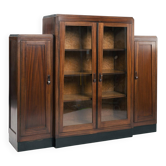
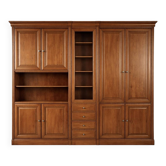
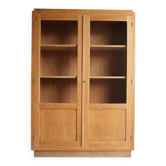
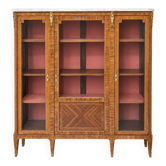
Art Deco Cabinet Attributed to Architect Joseph De Bruycker, Belgium 1938
This item has found its owner, but other one-of-a-kind items await you. 👇
Discover similar items- Dimensions :
- H200 x W170 x D34
- Color :
- brown
- Material :
- aluminium
- Style :
- modernist / bauhaus
A rare and architecturally poised example of Belgian Art Deco, this cabinet—attributed to Joseph De Bruycker and dating to 1938—embodies the geometric clarity and volumetric elegance that defined the movement’s mature phase. Designed for a residential interior conceived, the piece reflects his signature approach: a modernist interplay of stacked forms, rhythmic symmetry, and restrained ornamentation. The cabinet is composed of three distinct sections: a central body with solid wooden doors flanked by two glazed compartments, each fitted with shelves for display. The cabinet is made out of two volumes giving the design a unique tension between each layers. The vertical aluminum handles on the central doors offer a sleek industrial counterpoint to the warmth of the wood grain, while the black lacquered base anchors the composition with graphic precision. The overall silhouette is bold yet balanced, with a sculptural presence that evokes the architectural spirit of the interwar period. The aluminum handles are a typical element for Joseph De Bruycker and are a fine example of the heyday of the Art Deco period. Joseph De Bruycker, active in Belgium during the 1930s and ’40s, was known for his residential commissions that blended modernist ideals with decorative refinement. This cabinet, likely custom-made for one of his interiors, exemplifies the Belgian interpretation of Art Deco—less flamboyant than its Parisian counterpart, yet deeply committed to craftsmanship, proportion, and material integrity. De Bruycker has a modern style that consists of a succession of volumes and has a cubistic feel. Joseph Debruycker's furniture is rare and hard to find. What makes this cabinet unique. The geometric shapes and subtle details make this cabinet suitable for any interior. Often, he designed the furniture together with the house they were meant for creating interior design in harmony with the building.
5 ()
Display cases: other similar vintage pieces
Discover more similar items- -14%
- -35%
- -10%
- -42%
- -27%