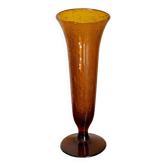
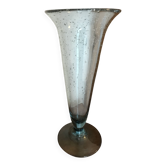
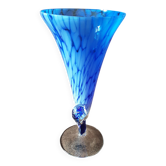
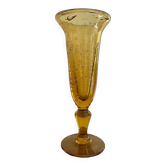
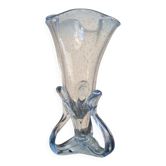
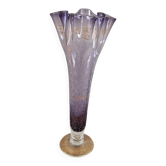
Modernism vase, purple glass, designed by J. Słuczan-Orkusz, Poland, 1970s

- Dimensions :
- H33 x W14 x D14
- Color :
- purple
- Material :
- glass and crystal
- Style :
- modernist / bauhaus
A vase designed by Jerzy Słuczan-Orkusz, produced by the Krakow Glass Institute in Poland in the 1970s, stands out with its modernist form reminiscent of a goblet with an elongated, slender stem and a distinctly flared bowl. Made of transparent glass in a noble amethyst purple with a warm gradient that lightens at the edge, it has no additional decorations – its decorative value is based on the pure line and subtle, vertical optical grooves emphasizing the vertical rhythm of the body. The combination of a wide, stable base with the body is executed with attention to detail characteristic of Polish artistic glass of the era. The glass has a smooth, glossy surface, free of bubbles, chips, or scratches, and the whole is preserved in excellent condition – without visible signs of use or conservation intervention. This design speaks with the voice of modernism at the turn of the PRL decades, where the contrast between color and simplicity of form became an expression of courage and the search for universality. The amethyst purple, gently spreading in the glass mass, recalls the fascination with noble colors and light at the time, which softly refracts on the cylindrical body. The expressive silhouette, oscillating between functionality and sculptural autonomy, carries echoes of the Polish school of glass, which in the 1970s focused on the coherence of material and form – as if every detail told of the ambition to enclose the contemporary spirit of the era in an everyday object. The vase can be placed solo on a wide table or console, where its slender, tall proportion will emphasize the rhythm of the interior, whether in a living room with a raw modernist character or in eclectic arrangements with elements of Polish 1970s design. It is worth pairing it with contrasting light ceramics or minimalist graphics leaning against the wall to highlight the value of the color and transparency of the glass. It creates the best dialogue with daylight, but it will also work great as an accent in a collection of glassware or on a wooden chest of drawers with a distinct grain.