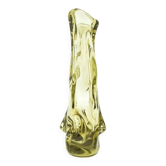
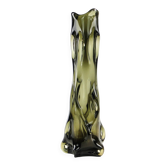
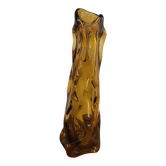
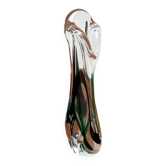
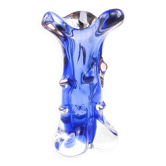
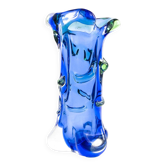
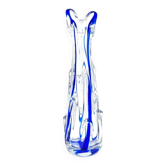
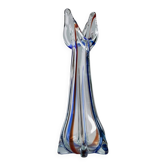
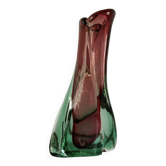
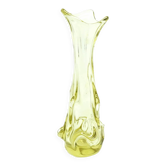
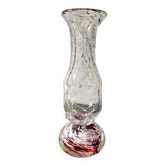
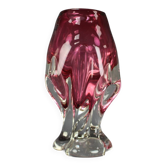
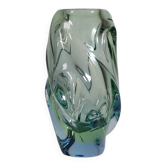
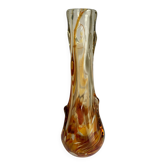
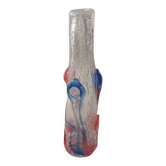
Sekacz vase, crumpled glass, Huta Wołomin, Poland, 1980s

- Dimensions :
- H24 x W8 x D8
- Color :
- grey
- Material :
- glass and crystal
- Style :
- vintage
The Prodimex vase from Huta Wołomin was made in the 1980s using a specific technique of crumpled, hand-formed glass, characteristic of the late modernism and organic abstraction of that period. The body, maintained in a deep, smoky grey tone with a cool shade and high gloss, displays fluid, almost wavy deformations and an irregular form. The surface is highly reflective, highlighting the play of light on the corrugated structure, and the elongated body of the vase smoothly transitions into an asymmetrical, widely flared opening reminiscent of a trumpet. The glass is massive in places—especially at the base—and gradually becomes more delicate at the edge, confirming the use of the free-blown technique typical of original works of that time. The construction has no visible joints or fittings. The condition is described as very good—no signs of intensive use or damage, and the original sticker confirms the authenticity of the product. The vase's form reads like a manifesto of the 1980s: the vessel abandons classical symmetry and decorativeness in favour of the expression of material, movement, and light. Holding the weight of dense glass in your hands, you can feel the energy of experiments transforming the traditional craft base into a sculptural everyday object. The shimmering surface, whose folds invite the eye to follow every break of light, makes you think of the search for freedom—a glass medium that tells its own story without words, solely through form and reflections. The vase can be placed on a lacquered chest of drawers, a stone countertop, or raw wood, where its play of lights and shadows will be best displayed. It works well as a solo accent in a minimalist or eclectic collector's arrangement, requiring the company of ascetic forms—a low ceramic bowl, a metal candlestick, or a single graphic poster. For contrast, it is worth combining it with colourful glass or matte ceramics to emphasise both the modern and industrial dimension of its style. The vase was made using the free-blown glass technique, with locally variable wall thickness, while the thick base ensures stability. The material is resistant to light and easy to keep clean thanks to its smooth, shiny surface; hand washing with a soft cloth is recommended to avoid scratches. The product comes from Huta Wołomin—a significant centre of Polish artistic glass at the end of the 20th century.