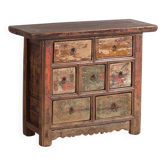
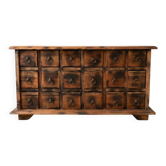
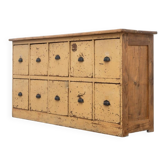
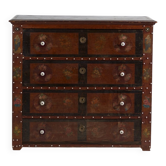
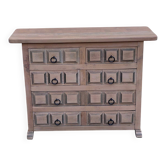
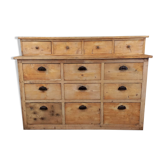
Antique Chinese apothecary furniture – China, circa 1910

- Dimensions :
- H95 x W102 x D54
- Color :
- wooden
- Material :
- wood
- Style :
- world's craft
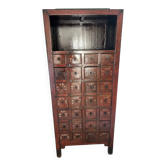
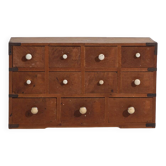
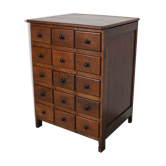
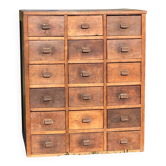
This antique Chinese apothecary cabinet made of pine features a grid of thirty drawers (6 columns × 5 rows), each with a circular wrought iron handle and handwritten Chinese calligraphy identifying the contents. It originates from northern China, dating from the end of the Qing dynasty, where the pine was crafted using traditional mortise and tenon joinery. Chinese apothecary furniture (yaogui 药柜) was central to traditional pharmacies. Each drawer held a medicinal herb, root, or mineral used in classical Chinese medicine, and the calligraphy painted on its front identified the contents according to the nomenclature of the Chinese herbarium. These pieces were often passed down through generations in pharmacist families. The body is constructed from solid pine. The front is arranged in a regular grid of thirty identical drawers, each with a wrought iron ring for pulling and hand-painted calligraphy in black pigment on a light background. The sides are solid and end in straight feet. A small moulding finishes the top. The joinery is traditional Chinese mortise and tenon, without screws. The light paint on the drawers—a cream or off-white background originally, now faded from use—retains the hand-painted calligraphy in black pigment. Most characters remain legible, allowing one to read which herb or substance was stored in each drawer. The palette combines cream white, bluish grey on the body frames, and natural oxidation on the iron fittings. Details. Dimensions: Length 102 cm – Depth 54 cm – Height 95 cm. Style: Qing Dynasty. Materials and techniques: Solid pine; wrought iron fittings; traditional Chinese mortise and tenon joinery; light paint on the drawers with handwritten Chinese calligraphy. Place of origin: China. Period: End of the Qing Dynasty. Date of manufacture: Circa 1910.
5 ()