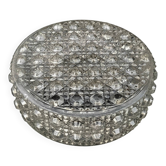
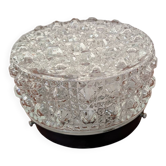
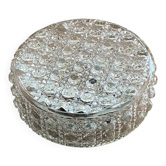
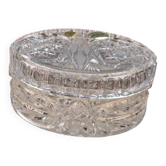
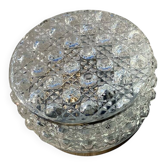
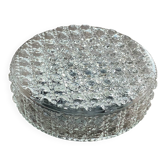
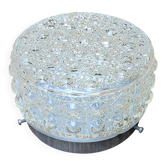
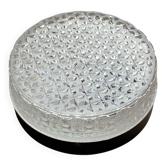
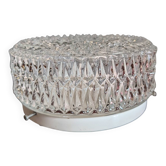
Bonbonniere, Vienna Secession, pressed glass, Belgium, 1930s

- Dimensions :
- H9 x W13 x D13
- Color :
- transparent
- Material :
- linen
- Style :
- art nouveau
A round bonbonniere made of pressed glass presents the characteristic Vienna Secession design of the 1930s. The transparent, colourless glass with a cool hue forms a compact, cylindrical shape with a low profile and even wall thickness. The surface is decorated with a geometric pattern of raised diamonds and large, faceted oval motifs, both on the body and the lid. The motifs clearly refract light, giving the whole a strongly decorative and chiaroscuro effect. The lid is closed with a hinge and clasp made of shiny, silvery metal—probably nickel-plated or chrome-plated—smoothly finished without additional ornamentation, balancing the richness of the glass details. Condition is very good—no visible signs of use or losses; the glass is clear, all elements remain original and from the period, with no signs of restoration or patina. In this bonbonniere, one can find the voice of European Secession in the last years of its triumph—the clarity of the pattern and form echoes the ambition of designers to give everyday objects sculptural strength. Pressed glass, a material full of light, evokes times when daylight played on faceted surfaces, and geometric decorations blurred the line between utility and ornament. This is an object that could tell the story of a city salon in interwar Antwerp—craftsmanship attention to detail fits the spirit of the era: transparency, simplicity, and ornamentation combined in one item. The bonbonniere can be freely combined with mirrors with geometric frames or other pressed glass vessels to emphasise its highly reflective character. It works well on a console in a retro-style living room, a chest of drawers in a bedroom, or as a jewellery box for storing small items on an art deco dressing table. In a collector's arrangement, it is worth combining it with brass accessories or pastel ceramics—achieving a contrast of textures and styles typical of eclectic interiors inspired by the 1920s and 1930s.
Sweet boxes & sugar bowls: other similar vintage pieces
Discover more similar items- -10%
- -11%
- Sold out